Table Of Content
One such example is the measure of subject QoL, which, as made evident by this scoping review, was not measured in any study record included, but is of utmost importance to truly indicate the overall long-term impact of ABA. Moreover, as the children and youth who participated in ABA-based and other interventions become adults, the long-lasting effects of these interventions should be investigated more thoroughly. In summary, the above results can be visualized through a filter of the study records (Fig. (Fig.5).5). Out of the 770 (100%) study records that were reviewed in depth, most showed positive results. When study records that used a method with a potential bias for positive results—such as those that compared one ABA treatment to another or assessed the mastery or criterion of a skill or behavior—were excluded, 361 (47%) study records remained. Furthermore, when study records that did not compare to a control or other intervention were excluded, 32 (4%) of the study records remained.
Desirable Qualities of Baseline Data
Multiple-probe designs may not be appropriate for behaviors with significant variability because the intermittent probes may not provide sufficient data to demonstrate a functional relationship. If a stable pattern of responding is not clear during the baseline phase with probes, the continuous assessment of a multiple-baseline format may be necessary. Overall, ABAB designs are one of the most straightforward and strongest SSED “treatment effect demonstration” strategies. Ethical considerations regarding the withdrawal of the intervention and the reversibility of the behavior need to be taken into account before the study begins. Further extensions of the ABAB design logic to comparisons between two or more interventions are discussed later in this article.
Methods
The generality test confirmed that the prompt-fading procedure identified as most efficient in the prompt-fading assessments continued to promote the most efficient response acquisition across new skills. Both MTL and LTM prompting can effectively improve independent responding when compared to baseline levels of responding or control procedures (for a review, see Demchak 1990). A few studies have directly compared the effectiveness and efficiency of these two popular procedures (Libby et al. 2008; McConville et al. 1998; Walls 1981).
Who provides ABA services?
The second “A” phase acts as both the withdrawal condition for the ABA portion of the experiment and the baseline phase for the ACAC portion. This design is ideal in situations where an ABA or ABAB study was planned but the effects of the intervention were not as sizable as had been hoped. Under these conditions, the intervention can be modified, or another intervention selected, and the effects of the new intervention can be demonstrated. The design has the same advantages and disadvantages of basic withdrawal designs but allows for a comparison of effects for two different treatments. A major drawback, however, is that the logic of SSEDs allows only for the comparison of adjacent conditions. This restriction helps to minimize threats to internal validity, such as maturation, that can lead to gradual changes in behavior over time, independent of study conditions.
Nonparametric statistical tests for single-case systematic and randomized ABAB…AB and alternating treatment ... - ScienceDirect.com
Nonparametric statistical tests for single-case systematic and randomized ABAB…AB and alternating treatment ....
Posted: Wed, 27 Dec 2017 00:58:04 GMT [source]
Quantitative Techniques and Graphical Representations for Interpreting Results from Alternating Treatment Design

A visual analysis of the results reveals large, immediate changes in percentage of vocal approximations emitted by the student each time the independent variable is manipulated, and there are no overlapping data between the baseline and intervention phases. As a result, this case would be considered strong evidence supporting the effectiveness of the intervention based on the WWCH evidence-based practice criteria. These included the presence of follow-up, whether interventions assessed mastery or criterion, and whether interventions assessed generalization.
Withdrawal (ABA and ABAB) Designs
There is, however, a change in trend, as there is a consistent decreasing trend during the baseline phase, which is reversed in the intervention phase. Within the cohort of study records, 41% had some follow-up measure, 40% had some criterion or mastery measure, and 31% of publications had some generalization measure. In the study records reviewed, 33% had one or two participants, whereas 31% of the publications had three participants, and 13% had four.
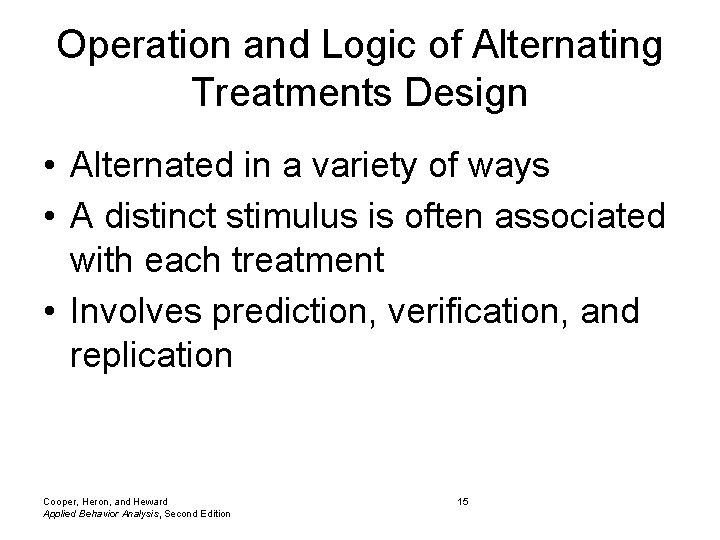
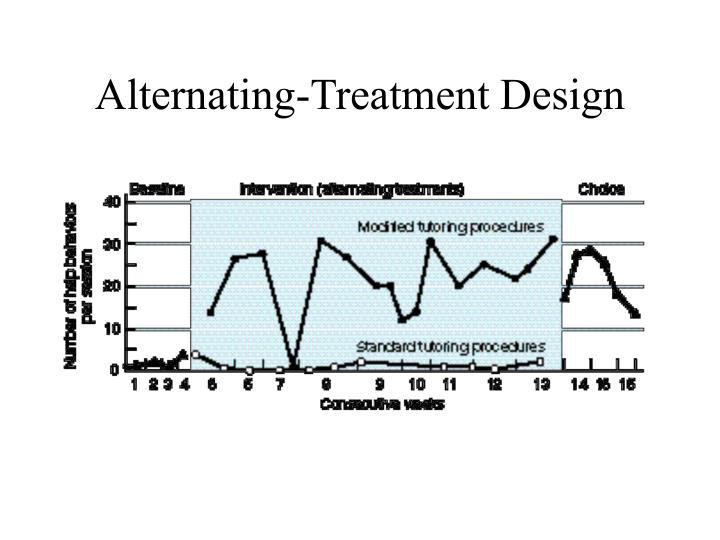
Alternating Treatments and Adapted Alternating Treatments Designs
The superiority of the Spanish instruction was evident in this case because there was no overlap in correct responding or inappropriate behaviors between the English and Spanish conditions. It is worth noting that although they are often used interchangeably in the literature, the terms withdrawal design and reversal design refer to two related but distinctly different research designs. In the withdrawal design, the third phase represents a change back to pre-intervention conditions or the withdrawal of the intervention.
Identified Studies
After removing duplicates or entries already existing in the database search, 1,577 entries remained from the database search and 525 from reviews, for a total of 2,102 records. Instead, their selected articles were screened and added to the sample if they were not already included in the initial search. These additions were excluded from the publication date limitation, resulting in the inclusion of a number of studies outside of the initial search date range. Scoping reviews differ from systematic reviews in that they provide an overview of existing evidence regardless of the quality (Tricco et al., 2016), and may not formally assess study rigor (Arksey & O’Malley, 2005). Interventions to address the needs of autistic individuals have been extensively researched.
These results may indicate gaps in the current ABA research approach, further supporting previous research about the standard of existing ABA literature (Reichow et al., 2018; Smith, 2012). These findings also support recommendations from Smith (2012), suggesting that RCTs comparing ABA to other interventions may be instrumental in evaluating both individual and global changes, as well as revising existing intervention models. Many records from the current search investigated the effectiveness of different ABA methods or variables in delivery.
In some cases, the simultaneous and continuous data collection in all legs of multiple-baseline designs is not feasible or necessary. Multiple-probe designs are a common variation on multiple baselines in which continuous baseline assessment is replaced by intermittent probes to document performance in each of the conditions during baseline. Probes reduce the burden of data collection because they remove the need for continuous collection in all phases simultaneously (see Horner & Baer, 1978, for a full description of multiple-probe designs). Pre-intervention probes in Condition 1 are obtained continuously until a stable pattern of performance is established. Meanwhile, single data collection sessions would be conducted in each of the other conditions to assess pre-intervention levels. Once responding has reached the criterion threshold in the intervention phase of the first leg, continuous measurement of pre-intervention levels is introduced in the second.
A paired-stimulus preference assessment (Fisher et al. 1992) was conducted to identify preferred edible items. During subsequent sessions, the three items identified as most preferred were provided by the interventionist contingent on correct prompted and independent responding. At the beginning of each experimental session, the participant was asked to choose one of the three preferred items and that item was used for the remainder of the session. The interventionist conducted a second preference assessment for activities (e.g., iPad) with Sean during the prompt hierarchy comparison phase, because Sean’s teacher independently chose to restrict access to edibles throughout the day.
The BC comparison, however, is never repeated in this sequence, limiting the internal validity of the comparison. Table S8 (located in Appendix 5) displays the Comparisons of ABA Techniques group analysis of various intervention categories compared in the outcome measures. Teaching was the most commonly compared intervention category across six outcome measures, ranging from 38% to 64%, except for emotional (25%), and autism symptoms (10%). Comparing ABA interventions was the most commonly studied comparison in the emotional outcome (50%; 2 out of 4 comparison records), and subject/setting characteristics was the most commonly studied comparison in the autism symptom outcome (70%; 7 out of 10 comparison records).